LITT
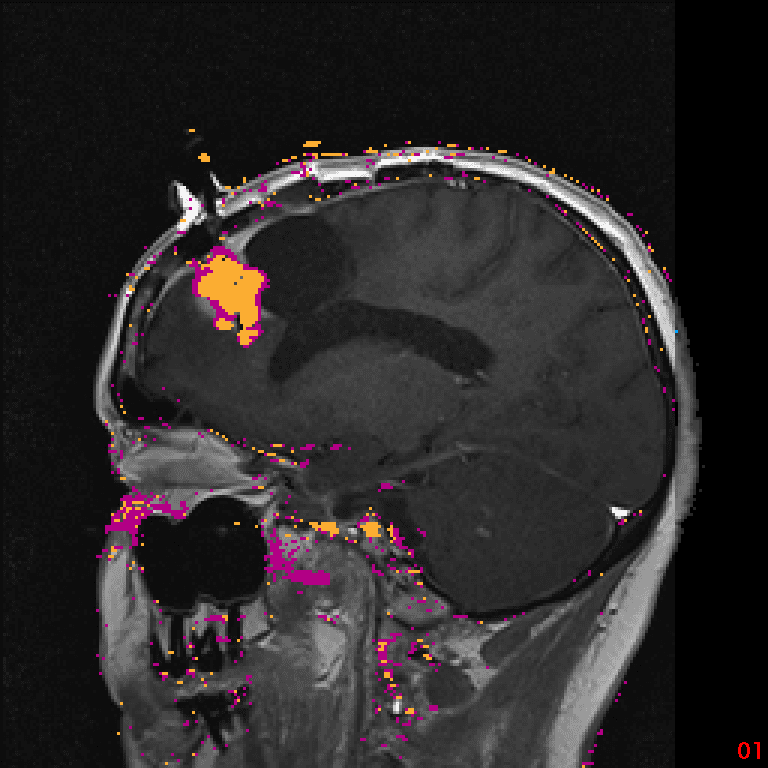
Laser Interstitial Thermal Therapy: a minimally invasive way to reach and treat tumors deep in the brain, guided by real-time MRI.
What Is LITT?
Laser interstitial thermal therapy, usually shortened to LITT, is a minimally invasive way to destroy abnormal tissue inside the brain using heat. Instead of opening the skull the way traditional surgery does, the neurosurgeon passes a thin laser fiber through a small opening about two to three millimeters across. The tip of the fiber heats the target tissue until the cells are destroyed. It does not involve a craniotomy, where a portion of the skull is removed.
The defining feature of LITT is that the entire ablation happens inside an MRI scanner. The MRI does more than guide the fiber into place. It produces a live temperature map of the brain, a technique called MRI thermometry, so the surgeon can watch the heat spread through the target in real time and see how close it comes to nearby healthy structures. This feedback allows the energy to be adjusted moment to moment, with the goal of treating the abnormal tissue while protecting the brain around it.
The treated tissue is not removed from the brain. It stays in place, and over the weeks and months that follow, the body gradually breaks it down and resorbs it. This is why follow-up imaging over time matters, and why the treated area often looks different on scans soon after the procedure than it does months later.
LITT is one of several tools used in brain tumor care, not a replacement for surgery, radiation, or systemic therapy. Dr. Sherman has experience with laser interstitial thermal therapy at Rutgers Cancer Institute in New Brunswick, NJ, the only NCI-designated comprehensive cancer center in New Jersey, where it is used alongside open surgery, stereotactic radiosurgery, and medical oncology.
Call our office at 732-235-6333 or send us a message.
The information on this page is general educational information and is not medical advice. It does not create a doctor-patient relationship or reflect a treatment recommendation for any individual. Treatment decisions require an individual evaluation by a qualified physician.
Conditions Treated with LITT
LITT is most often considered for deep, recurrent, or hard-to-reach tumors, and for radiation necrosis after earlier treatment. Each condition page covers symptoms, diagnosis, and the full range of treatment options.
- High-Grade GliomaDeep or recurrent high-grade gliomas can be candidates for laser ablation.
- GlioblastomaLITT is often considered for recurrent glioblastoma when repeat open surgery is not the best option.
- Brain MetastasesRecurrent metastases and radiation necrosis after radiosurgery are common LITT targets.
Using XR Technology To Advance Medical Care
Dr. Sherman integrates VR and AR visualization into surgical planning and patient education, giving patients a clearer picture of their diagnosis and the approach to treatment.
Common Questions About LITT
LITT, or laser interstitial thermal therapy, is a minimally invasive procedure that uses a thin laser fiber to heat and destroy abnormal tissue inside the brain. The fiber is passed through a small skull opening, and the entire ablation is done inside an MRI scanner so the surgeon can monitor temperature in real time. It is used for certain tumors, recurrent tumors, and radiation necrosis.
Told a Tumor Is Hard to Reach? Ask About Your Options.
Dr. Sherman is accepting new patients at Rutgers Cancer Institute in New Brunswick, New Jersey. Whether you are facing a recurrence or want another perspective on a tumor described as inoperable, a consultation is the first step toward understanding what is possible.